As of November 18, 2026, a quantum computer capable of breaking the cryptography used by mainstream blockchains had not emerged. But changing that cryptography could take years. In an imToken-authored account of Ethereum’s preparations, the central question is not simply how to create a new key: it is how users could retain control of existing accounts and assets while the network changes how it verifies signatures.
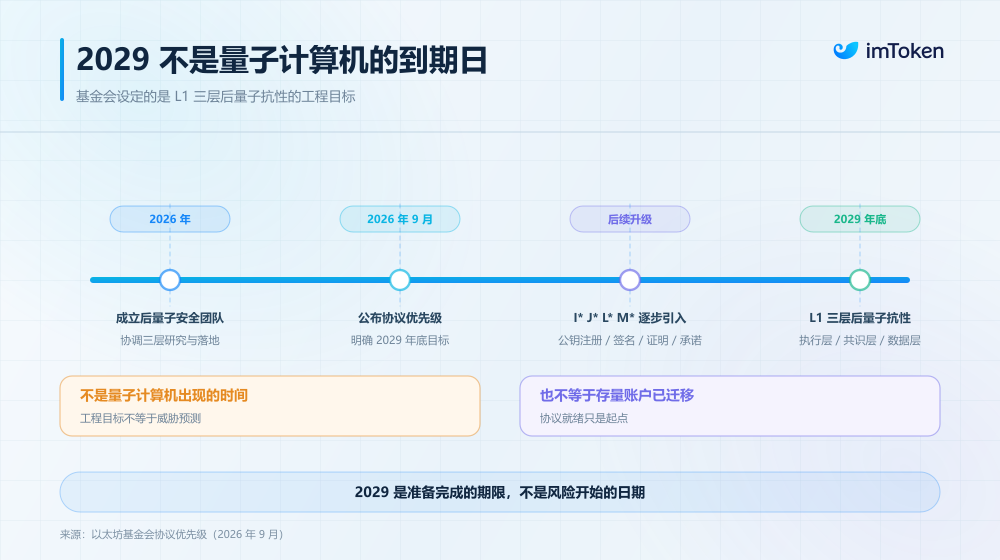
ImToken reports that the Ethereum Foundation established a Post-Quantum Security team in 2026. It also says protocol priorities published in September 2026 set an engineering goal of post-quantum resistance across Ethereum L1’s execution, consensus and data layers by December 2029. That is a target, not a completed upgrade.
Where the risks differ
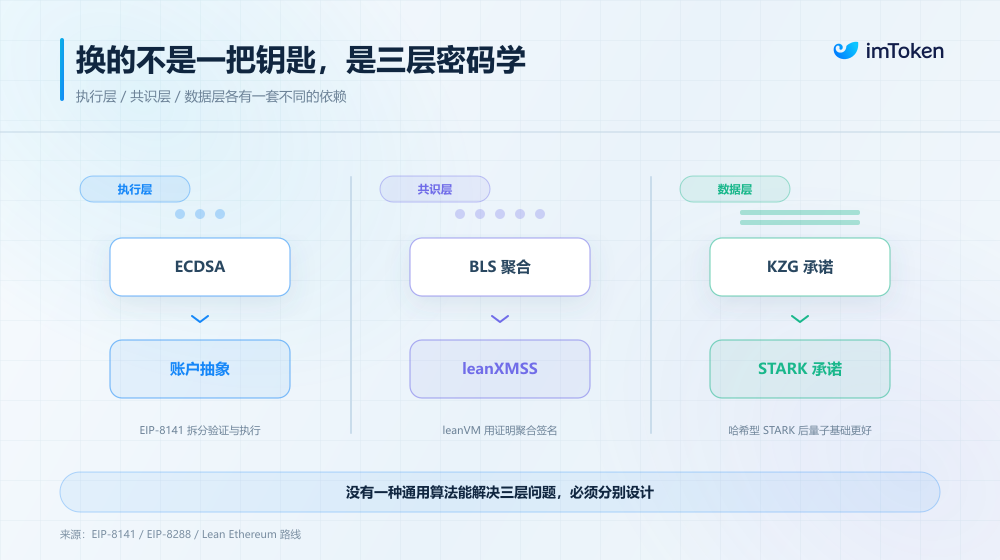
Ethereum’s ordinary externally owned accounts use ECDSA signatures, while proof-of-stake validators use BLS signatures. Both rely on elliptic-curve cryptography that a sufficiently capable fault-tolerant quantum computer could, in theory, undermine using Shor’s algorithm. That could put user accounts, validator keys and other signing authorities—including keys controlling cross-chain bridges—at risk.
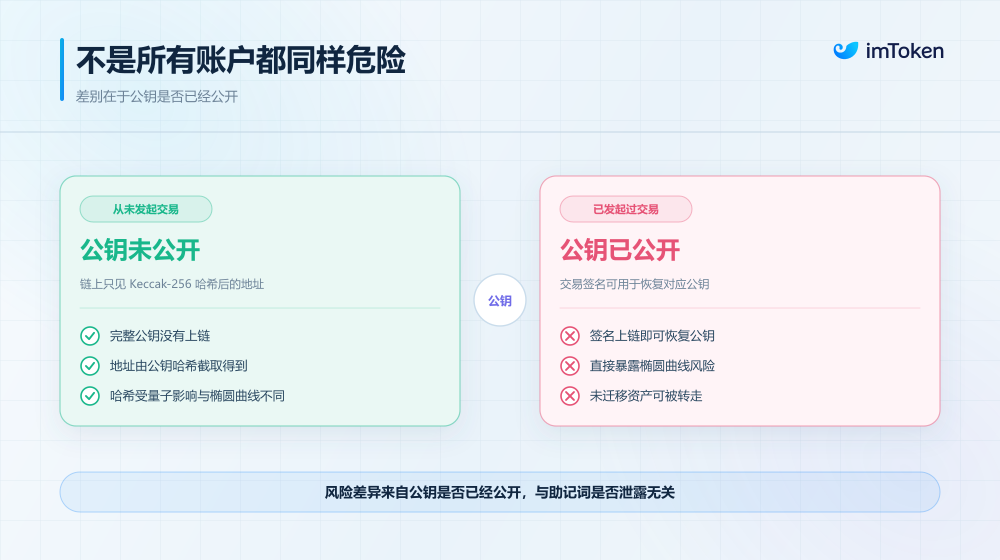
Exposure is not identical for every account. An ordinary Ethereum address is derived from a hash of its public key. According to imToken, an account that has never sent an on-chain transaction or disclosed an off-chain signature has not exposed its full public key in those ways. Once it signs a transaction, the public signature can reveal that key. This distinction does not mean unused accounts have a permanent solution; it explains why a future quantum threat would affect accounts differently.
Other components need separate treatment. Ethereum uses KZG commitments for blob and rollup data availability, and some application-layer zero-knowledge proofs rely on elliptic-curve assumptions. Hash-based constructions, including STARKs, do not rely on the same elliptic-curve discrete-logarithm assumption.
The proposed upgrade paths
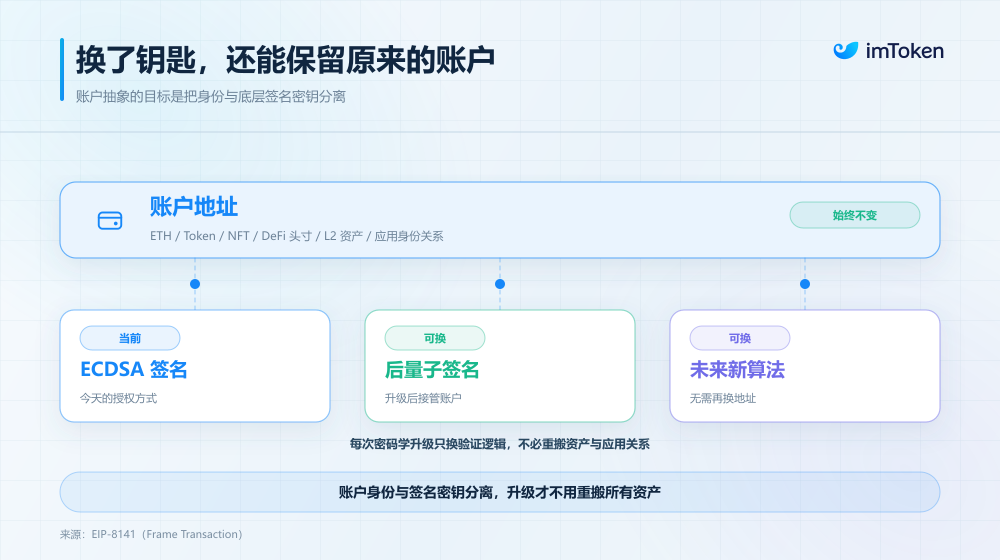
On the execution layer, native account abstraction is one route under discussion. ImToken highlights EIP-8141, which aims to separate transaction validation, execution and gas payment. Programmable validation could make it possible to change an account’s signing rules without necessarily changing its address. Research into post-quantum signature-verification precompiles and the recursive-STARK aggregation proposed in EIP-8288 addresses another constraint: post-quantum signatures can be much larger than today’s signatures. These are proposals and research directions, not capabilities every Ethereum account has today.
On the consensus layer, the Lean Ethereum directions described by imToken include leanXMSS, a hash-based candidate to replace validator BLS signatures, and leanVM, intended to help aggregate proofs of post-quantum signatures. A direct replacement would otherwise impose substantial network, storage and verification costs. The data layer also needs a path beyond quantum-vulnerable assumptions used by KZG commitments. None of these changes alone would complete a migration across L1, rollups and applications.
The wallet problem
For a traditional account, switching to a different key system may mean moving ETH, tokens and NFTs to a new address—and dealing separately with DeFi positions, L2 assets and application permissions tied to the old one. Account abstraction could potentially preserve an address while its validation rules change, but that depends on the account’s design and on upgrades that remain unfinished.
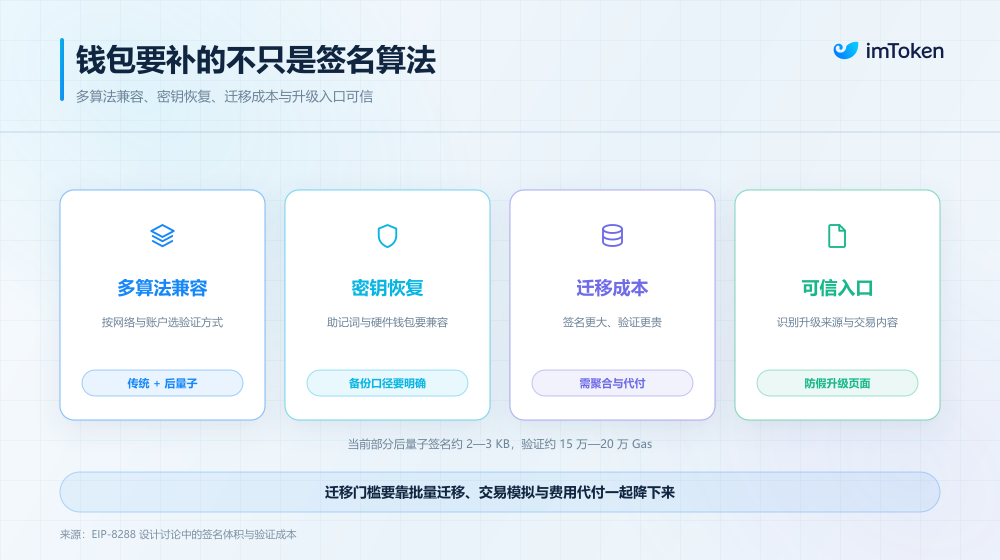
ImToken describes the preferable migration as one authorized by the existing key while that key remains secure. If an attacker could already forge its signatures, an old-key signature would no longer reliably establish who owns the account. Lost-key and long-dormant accounts present a further unresolved problem; whether any future governance process should freeze such assets remains disputed.
For users, this is not a reason to rush into a purported “quantum-safe” migration. ImToken warns that fake upgrade pages could instead seek seed phrases or malicious approvals. The practical challenge for wallet developers is to make any eventual change in signing authority understandable and verifiable without turning migration itself into a new attack path.