In an article published on November 11, 2026, ross.wei described Tacit Chain as a payment-focused zk-rollup prototype intended to make in-person crypto payments fast and private. The author’s test is simple: can someone pay for a coffee without making the merchant wait or exposing their transaction history? The article presents a design and claims about its capabilities, not independent evidence of merchant adoption.
Where Tacit Chain fits
The article contrasts three ways to move payments off a base chain. A sidechain can process transfers quickly, but its users must trust its operators and custody arrangements; Bitcoin’s Liquid, for example, uses a federation and multisignature custody. State channels, including those used by the Lightning Network, exchange signed balance updates after funds are locked, but users need a way to monitor for an outdated settlement attempt.

Rollups instead post transaction data to a base chain. An optimistic rollup allows time to challenge an invalid batch, which the article says can leave withdrawals waiting about a week. A zk-rollup submits a validity proof for the batch, avoiding that challenge period. Tacit Chain takes the latter approach and narrows its intended use to payments.

The proposed payment path
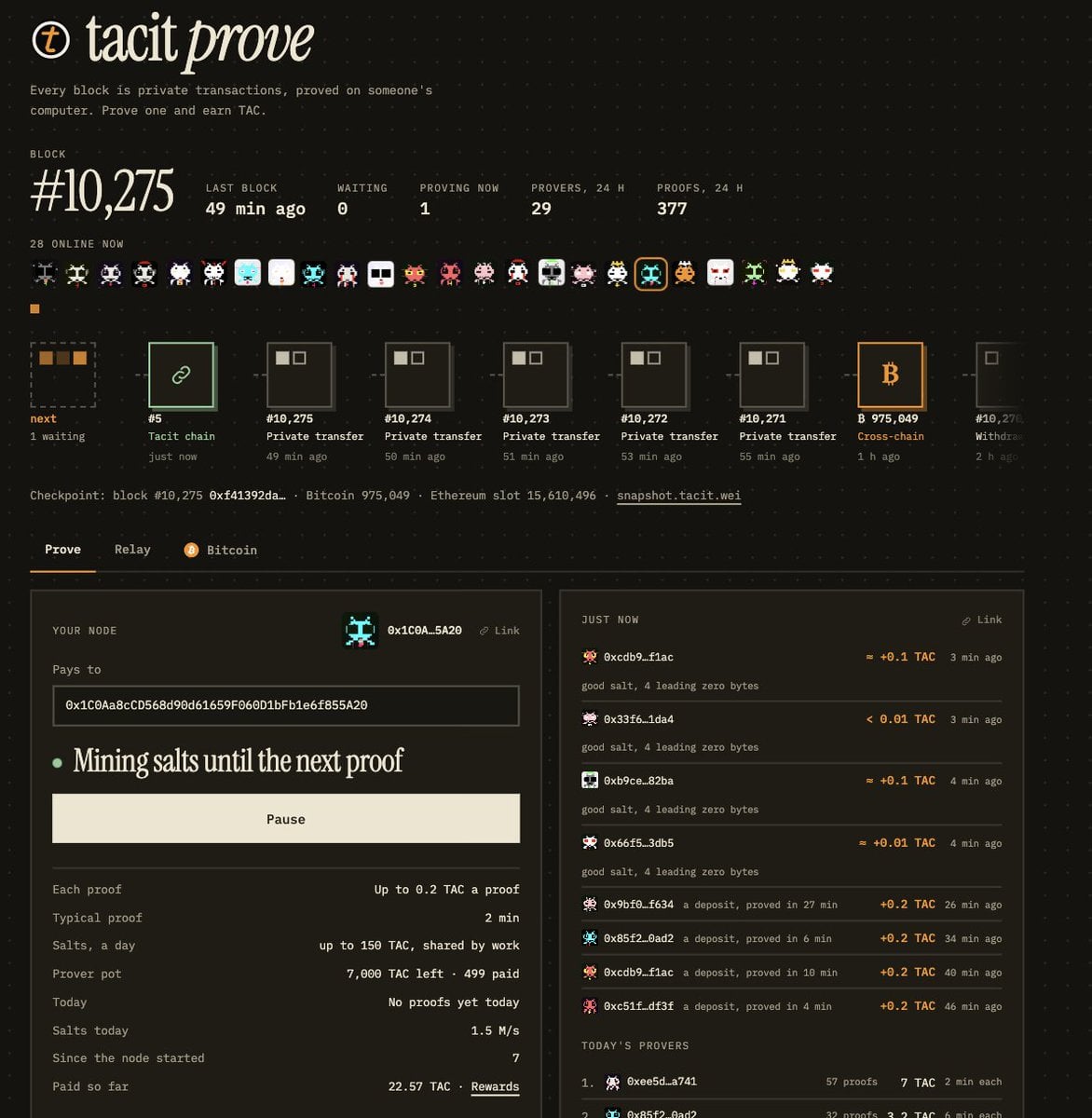
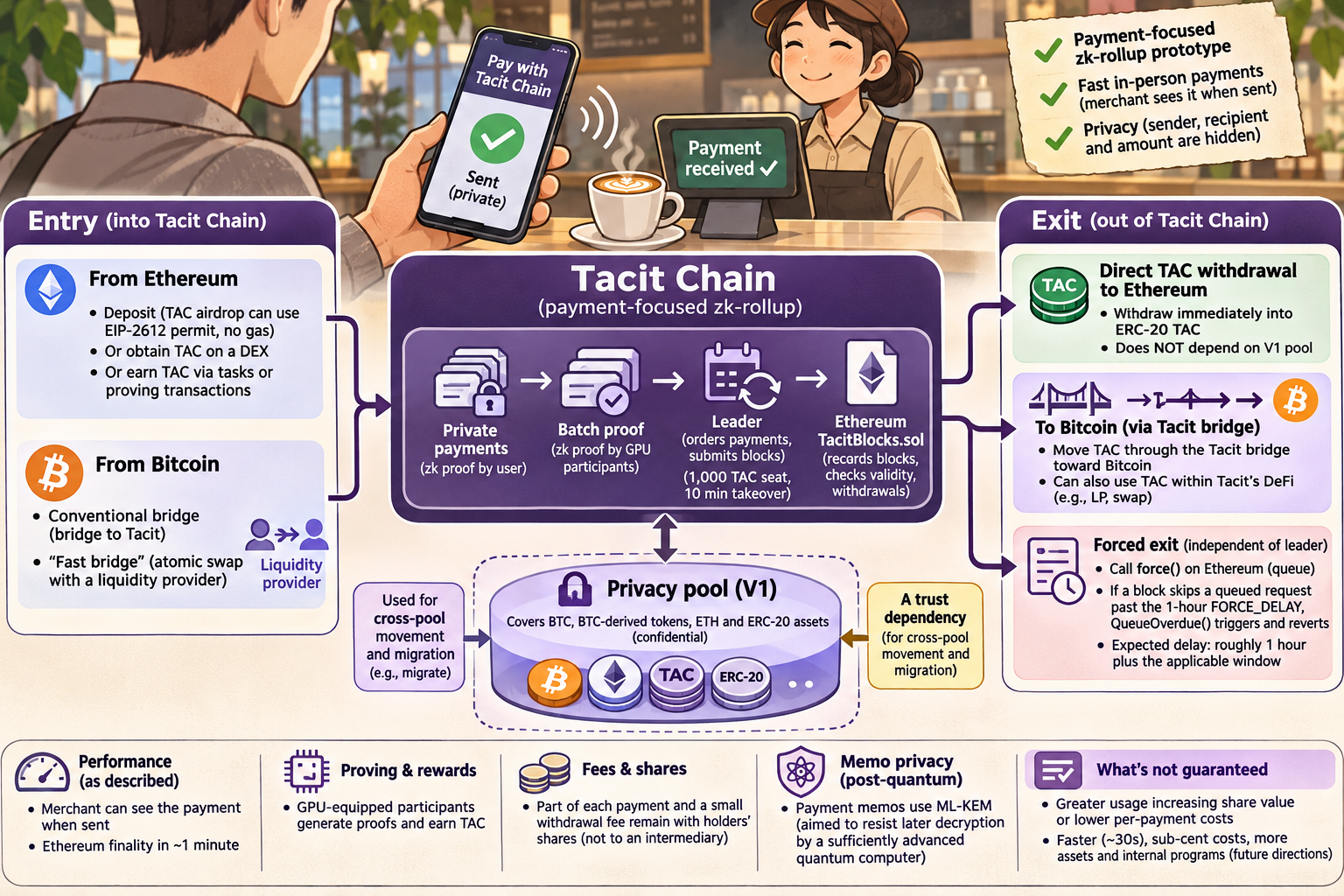
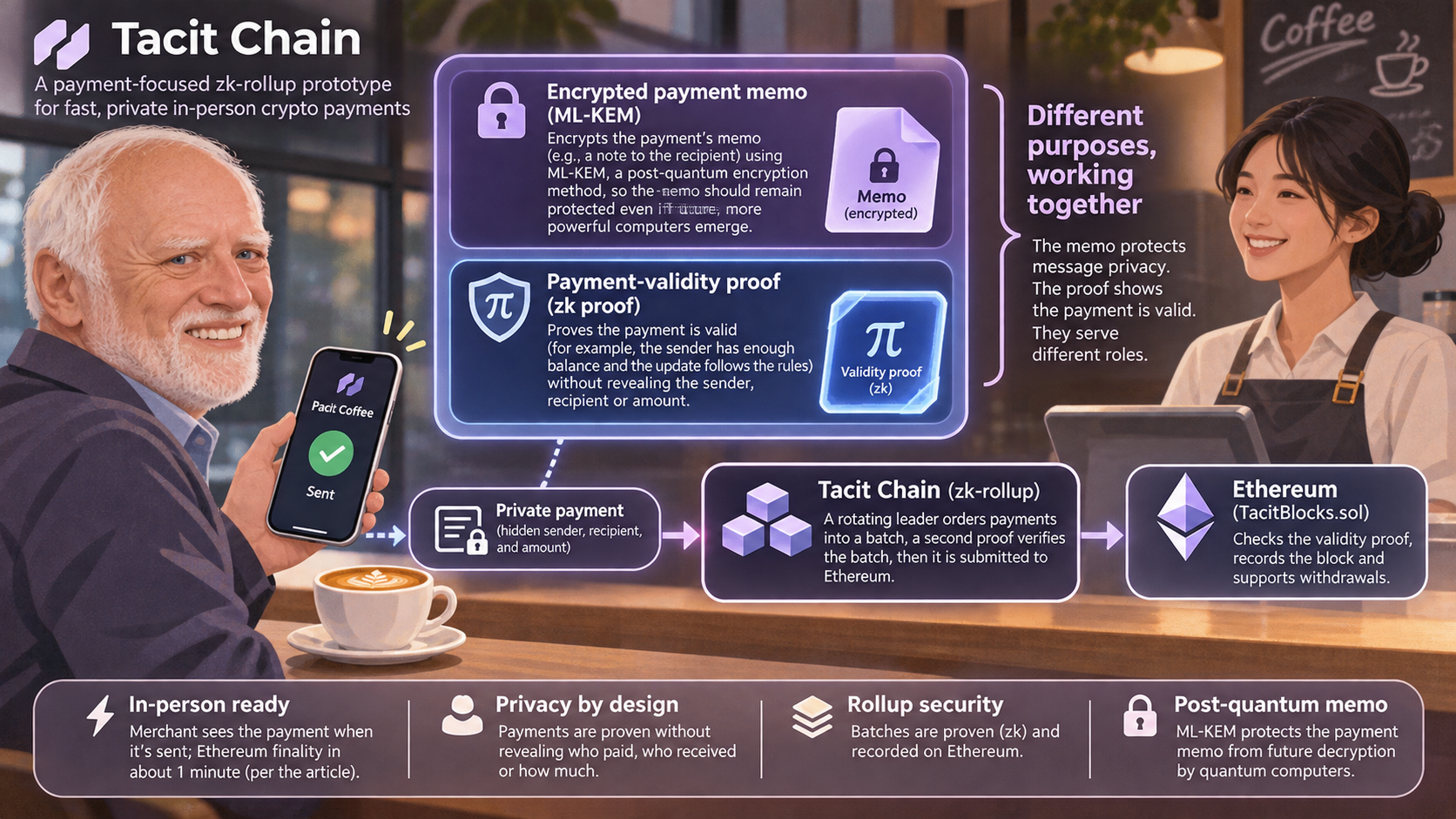
Under the design described by ross.wei, a user’s device proves that a payment is valid without revealing its sender, recipient or amount to the rollup verifier. A second proof checks the processing of the payment batch before Ethereum accepts it. GPU-equipped participants can generate proofs and earn TAC through a reward program, according to the article.
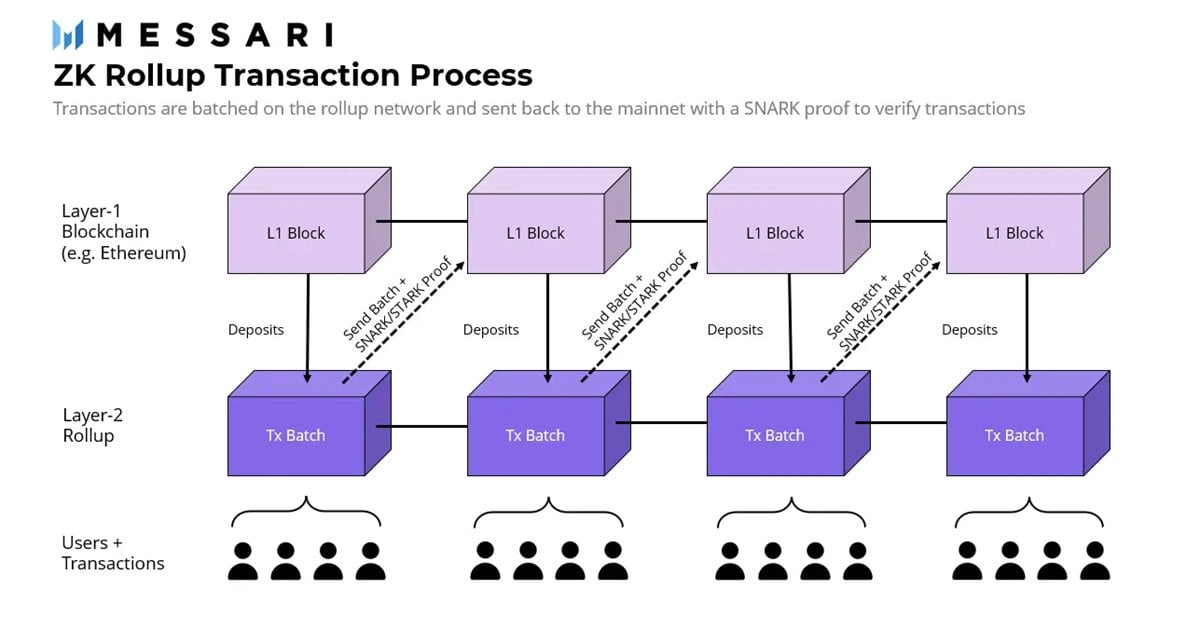
A rotating leader orders payments and submits blocks to the Ethereum contract TacitBlocks.sol, which records blocks, checks validity and supports withdrawals. Holding a 1,000-TAC seat qualifies a participant for a scheduled turn. If the scheduled leader does not submit, anyone can take over after 10 minutes. Leaders collect fees in TAC, which the article also describes as the rollup’s currency.
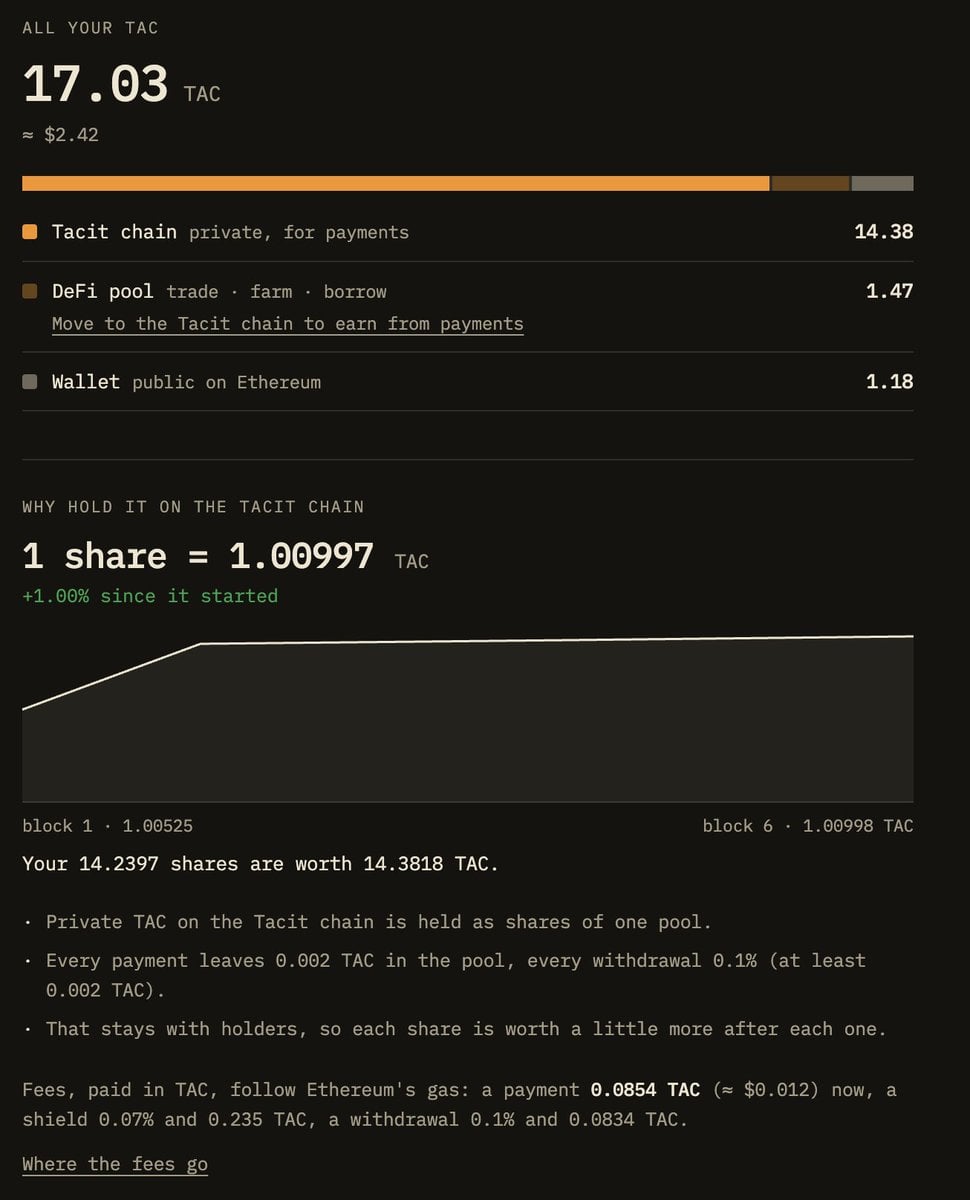
The article describes a shared-pool accounting system in which part of each payment and a small withdrawal fee remain with holders’ shares, rather than going to an intermediary. Its claims that greater usage could increase share value or lower per-payment costs depend on actual activity and costs; they are not guaranteed outcomes.
Entering, leaving and relying on bridges
The described entry routes include Ethereum and Bitcoin. The author says holders of a TAC airdrop could enter from Ethereum without paying gas through an EIP-2612 permit transaction. Other routes mentioned are obtaining TAC on a DEX or earning it through tasks or proving transactions. From Bitcoin, the options described are a conventional bridge or a “fast bridge” using atomic swaps with liquidity providers.
The plan also calls for a privacy pool covering BTC, BTC-derived tokens, ETH and ERC-20 assets. According to the article, a user could withdraw immediately into an ERC-20 form of TAC, then move it through a Tacit bridge toward Bitcoin or use it within Tacit’s DeFi facilities. These paths have different dependencies: an atomic-swap route needs a liquidity provider, while movement between pools and migration depend on the confidential V1 pool’s construction. The author says a withdrawal to Ethereum as a TAC transfer does not depend on V1.
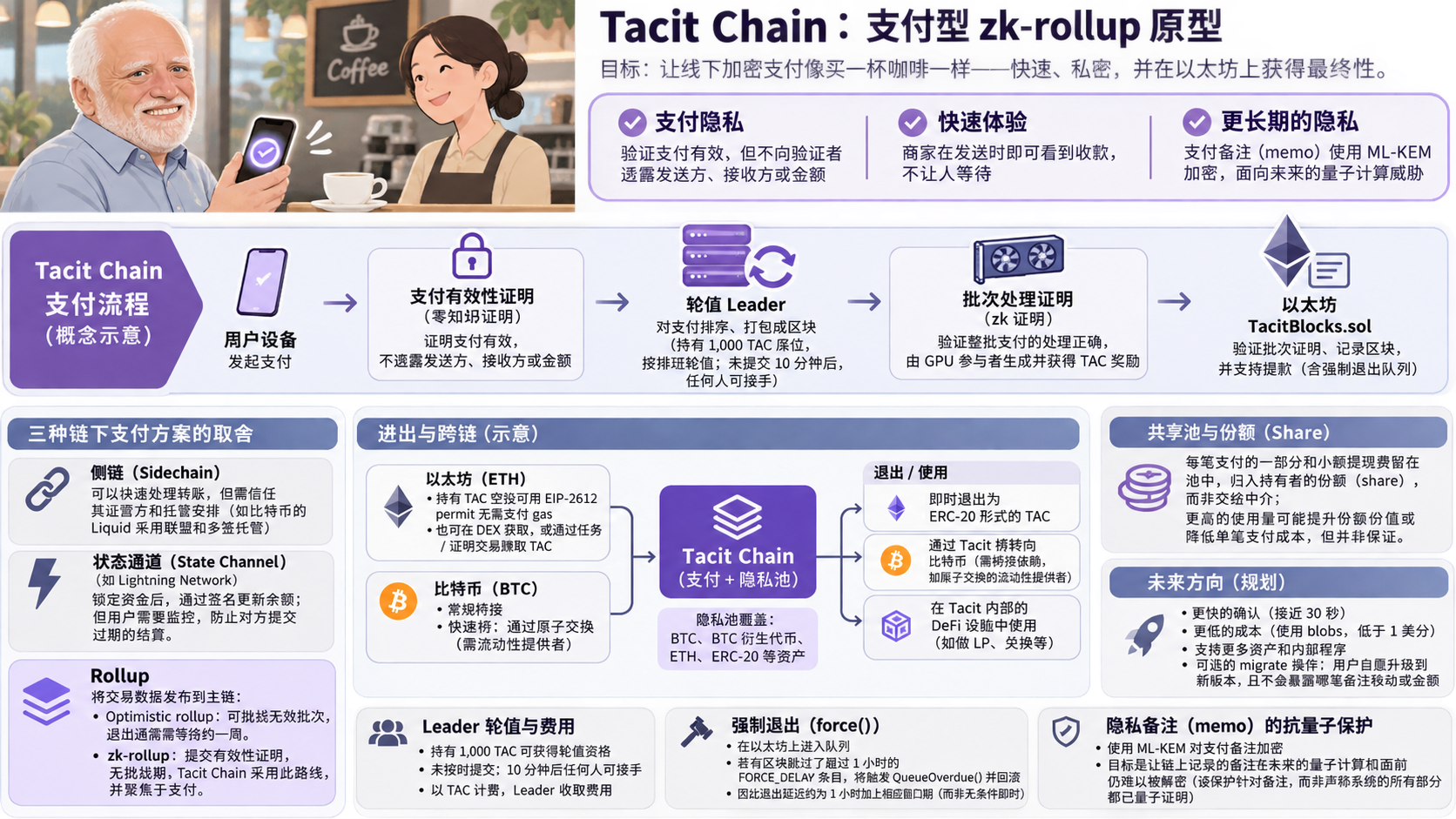
For an exit that does not rely on a leader’s cooperation, the design places force() requests in an Ethereum queue. The article says a block that skips a queued request past the one-hour FORCE_DELAY triggers QueueOverdue() and reverts. It describes the possible delay as roughly one hour plus the applicable window, rather than an unconditional instant exit.
Privacy claims and what remains to be shown
Tacit Chain’s post-quantum measure concerns encrypted payment memos: the article says they use ML-KEM so that a recorded memo should resist later decryption by a sufficiently advanced quantum computer. That is a narrower claim than saying every part of the system is quantum-proof.
Ross.wei argues that Tacit Chain meets an L2 “Stage 2” standard, citing immutable core contracts without owners, upgrade paths or multisignatures; a fixed SP1 Groth16 verifier; Ethereum calldata from which nodes can reconstruct state; and the forced-exit queue. This is the author’s assessment. The same account identifies the V1 pool as a trust dependency for cross-pool movement and migration, although it says that pool is also immutable and cannot take balances.
The author says a coffee payment can already be seen by a merchant when sent and reach Ethereum finality in about one minute. Faster confirmation approaching 30 seconds, costs below one cent using blobs, more assets and internal programs are presented as improvements or future directions—not established usage figures. A proposed migrate operation would let users opt into a new version without revealing which memo moved or its amount. For a newcomer, the distinction is between the payment flow the article describes, the trust required at its bridges and pools, and performance or expansion claims that would need to be demonstrated in use.