
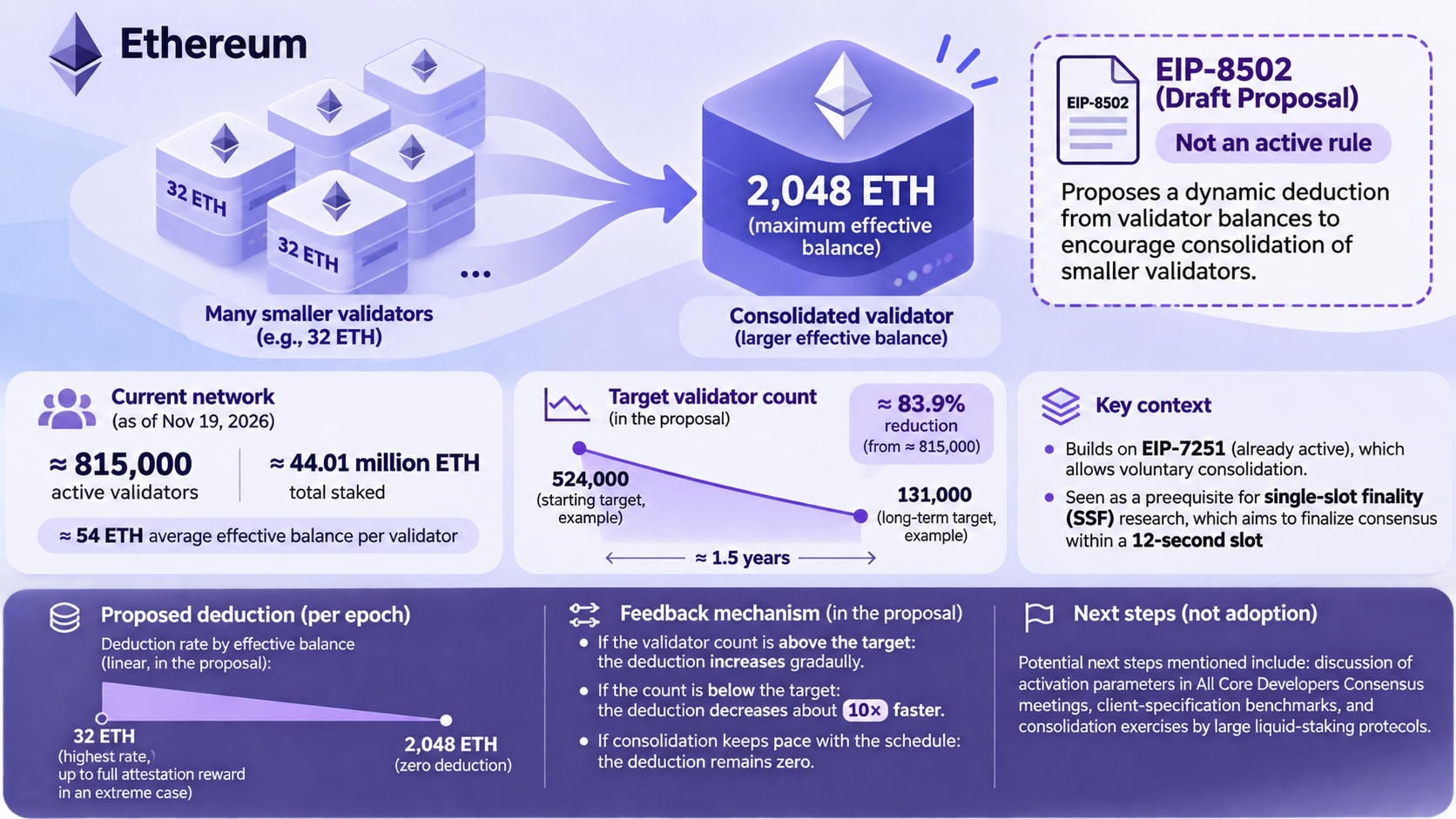
As reported on November 19, 2026, researcher Anders Elowsson had submitted EIP-8502, a draft proposal for Ethereum’s consensus layer. It would introduce a dynamic deduction from validator balances to encourage operators to consolidate smaller validators. The mechanism was not an active rule.
The problem it targets
The proposal’s technical rationale is that beacon-chain communication and signature-processing costs rise with the number of active validators, rather than simply with the amount of ETH staked. At the time of the report, Ethereum had approximately 815,000 active validators holding about 44.01 million ETH in total—an average effective balance of roughly 54 ETH per validator. The already-active EIP-7251 allowed voluntary consolidation, but did not impose an economic cost on operators who kept smaller validators separate.
How the proposed deduction would work
Under EIP-8502, a validator’s balance would be charged each epoch according to its effective balance and how far the network’s active-validator count exceeded a changing target. The proposed rate would be highest for a validator at 32 ETH; in an extreme case, the deduction could equal its full attestation reward. It would decline linearly as effective balance increased, reaching zero at the 2,048 ETH maximum effective balance.
The draft describes a target count falling over roughly 1.5 years from an example starting level of 524,000 active validators to an example long-term level of 131,000. Relative to the approximately 815,000 validators reported on November 19, that endpoint would represent a reduction of about 83.9%. The starting target is a proposal parameter, not the reported current validator count.
The proposed feedback mechanism would raise the deduction gradually when the validator count exceeded its target and lower it about 10 times faster when the count fell below target. If consolidation kept pace with the proposed schedule, the deduction would remain zero.
What remains open
The report frames validator consolidation as a prerequisite for Ethereum’s longer-term single-slot finality research, which aims to finalize consensus within a 12-second slot. EIP-8502 remained a Draft and depended on the EIP-7251 functionality already in place. According to the report, potential next steps included discussion of activation parameters in All Core Developers Consensus meetings, client-specification benchmarks and consolidation exercises by large liquid-staking protocols. None of those steps meant the proposed deductions—or single-slot finality—had been adopted.