As of the original reporting on November 23, 2026, Morpho’s FXRP/RLUSD market showed what can happen when someone borrows against XRP rather than selling it. Its activity record listed a November 14 liquidation in which a liquidator repaid 194,696.18 RLUSD and received 226,373.01 FXRP from a borrower’s collateral. The record does not identify the person behind the wallet or establish their overall profit or loss.
How the borrowing route works
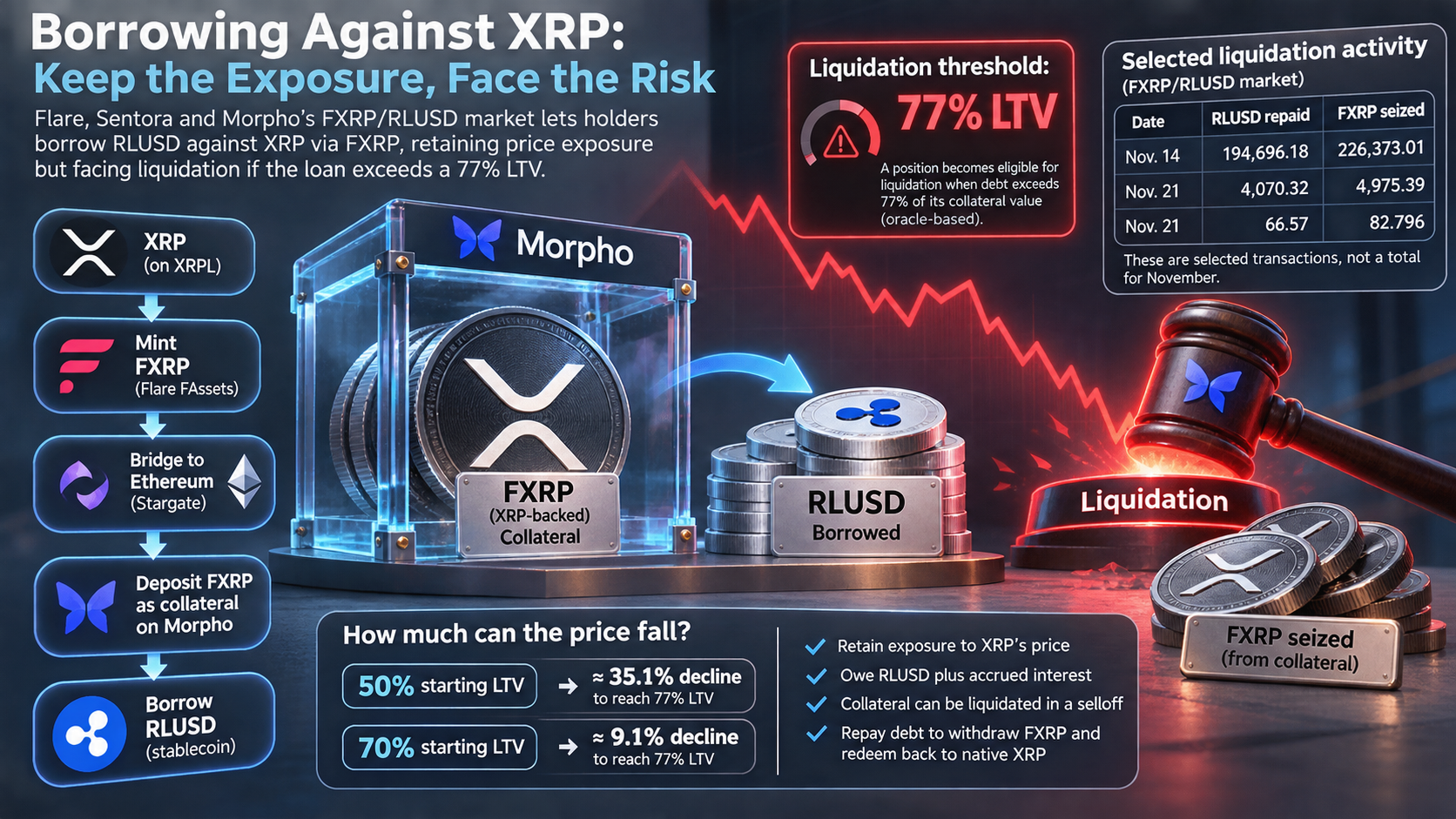
FXRP is an XRP-backed token created through Flare’s FAssets system; it is not a native XRP balance on the XRP Ledger. In August 2026, Flare and Sentora introduced a route for holders to mint FXRP, transfer it to Ethereum through Stargate, deposit it as collateral on Morpho and borrow Ripple’s RLUSD stablecoin. Borrowers retain exposure to XRP’s price, but owe RLUSD plus accrued interest.
At launch, Sentora’s RLUSD Main vault held $280 million in deposited RLUSD. That was the vault’s total, not an amount guaranteed to be available for FXRP loans. Market allocations and available liquidity determine what can be borrowed.
What the market record shows
The Morpho market lists a 77% liquidation loan-to-value (LTV) threshold. A position becomes eligible for liquidation when its debt exceeds 77% of its collateral value as measured by the market’s oracle. Besides the November 14 transaction, the activity record showed two liquidations on November 21:
| Date | RLUSD debt repaid | FXRP collateral seized |
|---|---|---|
| November 14 | 194,696.18 | 226,373.01 |
| November 21 | 4,070.32 | 4,975.39 |
| November 21 | 66.57 | 82.796 |
These are selected transactions, not a total for November. The displayed accounting reported zero realized bad debt for them, but the seized FXRP still left the borrowers’ positions. Dividing RLUSD repaid by FXRP seized would not produce a spot price: the collateral transfer includes a liquidator incentive.
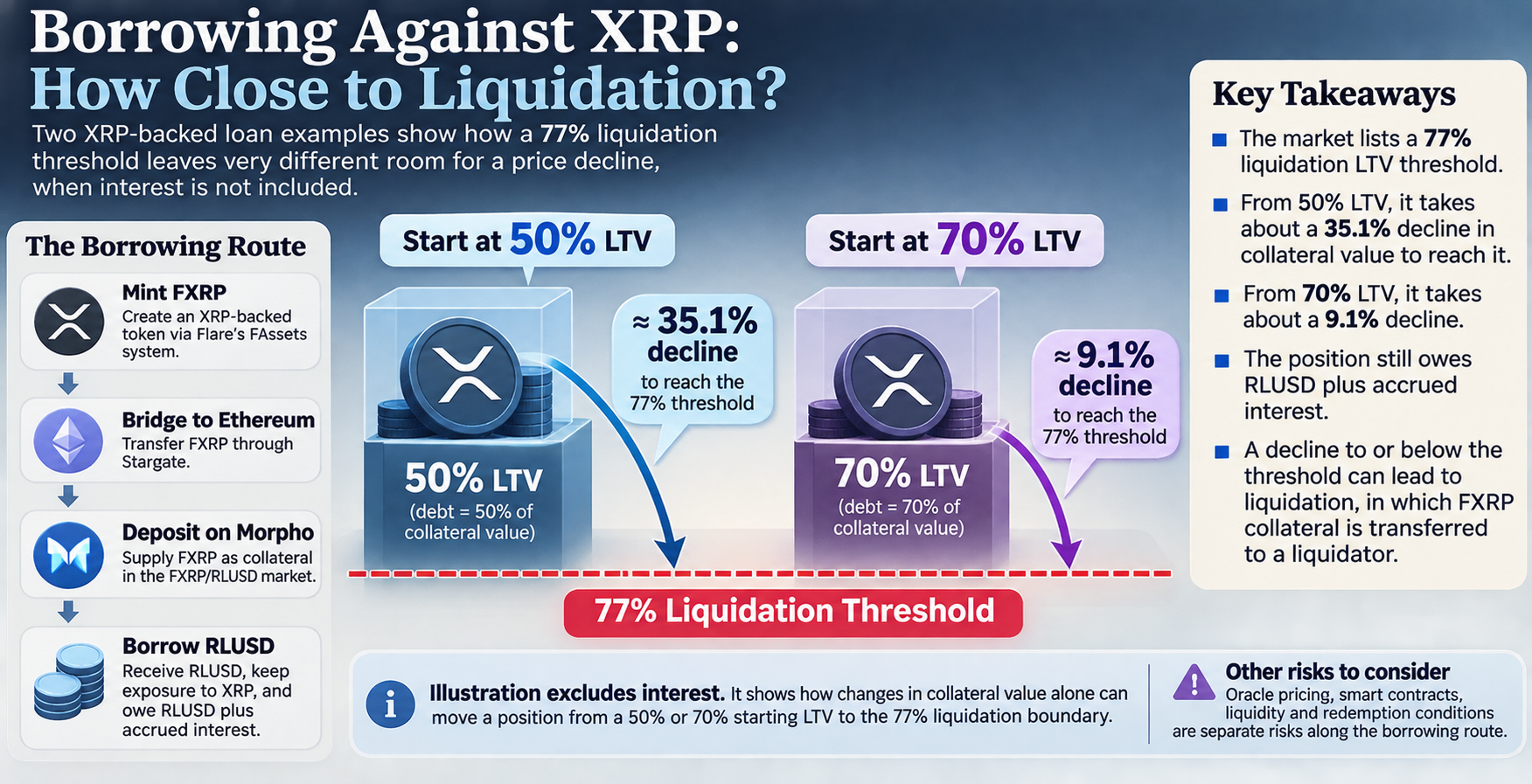
Starting LTV makes a substantial difference. In a hypothetical loan with unchanged debt and collateral quantity, a position starting at 50% LTV would reach the 77% boundary after roughly a 35.1% decline in collateral value. Starting at 70% LTV leaves room for only about a 9.1% decline. Those figures exclude interest; they are illustrations, not forecasts or descriptions of the liquidated wallets. Accrued interest can move a position closer to the threshold even if its FXRP balance does not change.
The route also has an exit sequence. A borrower must repay enough RLUSD to withdraw the desired FXRP; returning to native XRP then requires the applicable network transfer and FAssets redemption steps. Oracle pricing, smart contracts, liquidity and redemption conditions are separate risks along that path. Borrowing can avoid an immediate XRP sale, but it cannot guarantee that a holder will keep all their collateral through a selloff.