
An Ethereum transaction can use computing power for a moment, but a new account or storage slot adds data that nodes must continue to hold. That difference is the problem EIP-8037 is intended to address: the proposal would make creating state substantially more expensive without raising the cost of ordinary execution by the same amount.
This is a proposal, not a rule already in effect. In an article originally published on November 16, 2026, at 17:30 UTC+8, Vitalik Buterin argued that Ethereum has more room to expand execution capacity than its persistent state. The article was translated by Luffy for Foresight News and published by Odaily.
Where EIP-8037 fits
Buterin’s account separates several pressures that a higher gas limit could place on nodes: block-validation work, calldata transmission, state reads and writes, and the continuing growth of state itself. He described other proposals associated with Glamsterdam as addressing parts of that picture. Among them, EIP-7976 would raise calldata’s base price; EIP-7928 proposes block-level access lists to support parallel validation; EIP-8038 would raise state read-and-write costs; and EIP-7732, or ePBS, would extend the time available for safe block validation from roughly two seconds to half a slot, or six seconds.
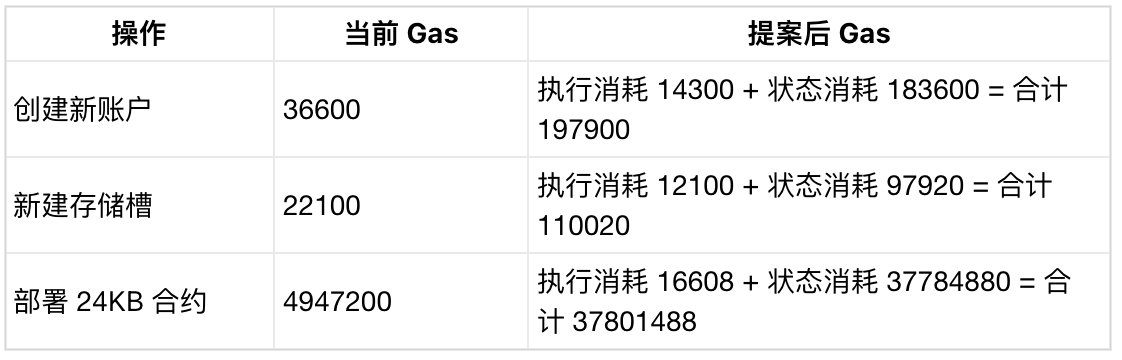
In Buterin’s assessment, those changes could help Ethereum accommodate much more execution work, but they would not sufficiently constrain new state. EIP-8037 takes a different step: it would sharply increase the gas charged for creating storage slots, deploying contracts and creating accounts, including by sending ETH to an address that does not yet exist. Its proposed state-pricing parameter, CPSB, starts at 1530 and could be raised later. Those are proposed parameters, not a guarantee of future pricing.
The reservoir—and its limits
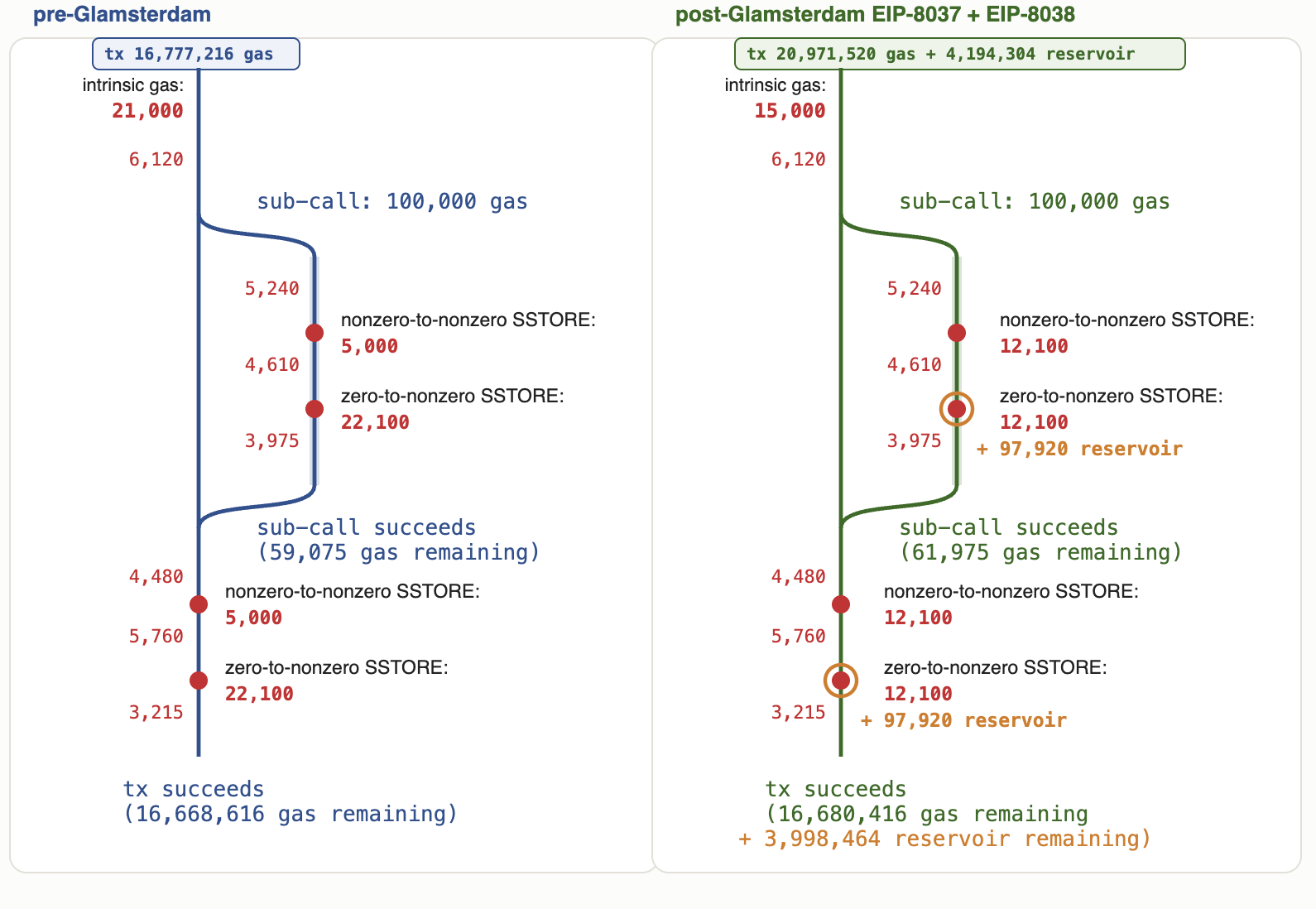
EIP-8037’s state gas reservoir would separate some state-creation costs from a transaction’s ordinary execution-gas allowance. Under the arrangement described in the article, state-creation operations would draw from the reservoir first and use ordinary execution gas only after it ran out. State gas would not count toward the stated 16.7 million gas per-transaction limit, allowing, for example, a 24 KB contract deployment to remain possible. Buterin also described EIP-8141 as a way for transactions to specify the two limits explicitly; that improvement would depend on a later protocol change.
The distinction matters to applications with fixed gas assumptions. Buterin identified bridge systems as a particularly difficult case: he wrote that an OP Stack bridge path with a hard-coded 40,000 gas limit could be made to fail by a transaction that does not supply a reservoir, even though that transaction is confirmed. He also flagged possible complications for gas accounting, refunds and ERC-4337 UserOperations. Separately, the proposed EIP-8038 increase in one SSTORE cost—from 5,000 to 12,100 gas—would not have the reservoir as a fallback.
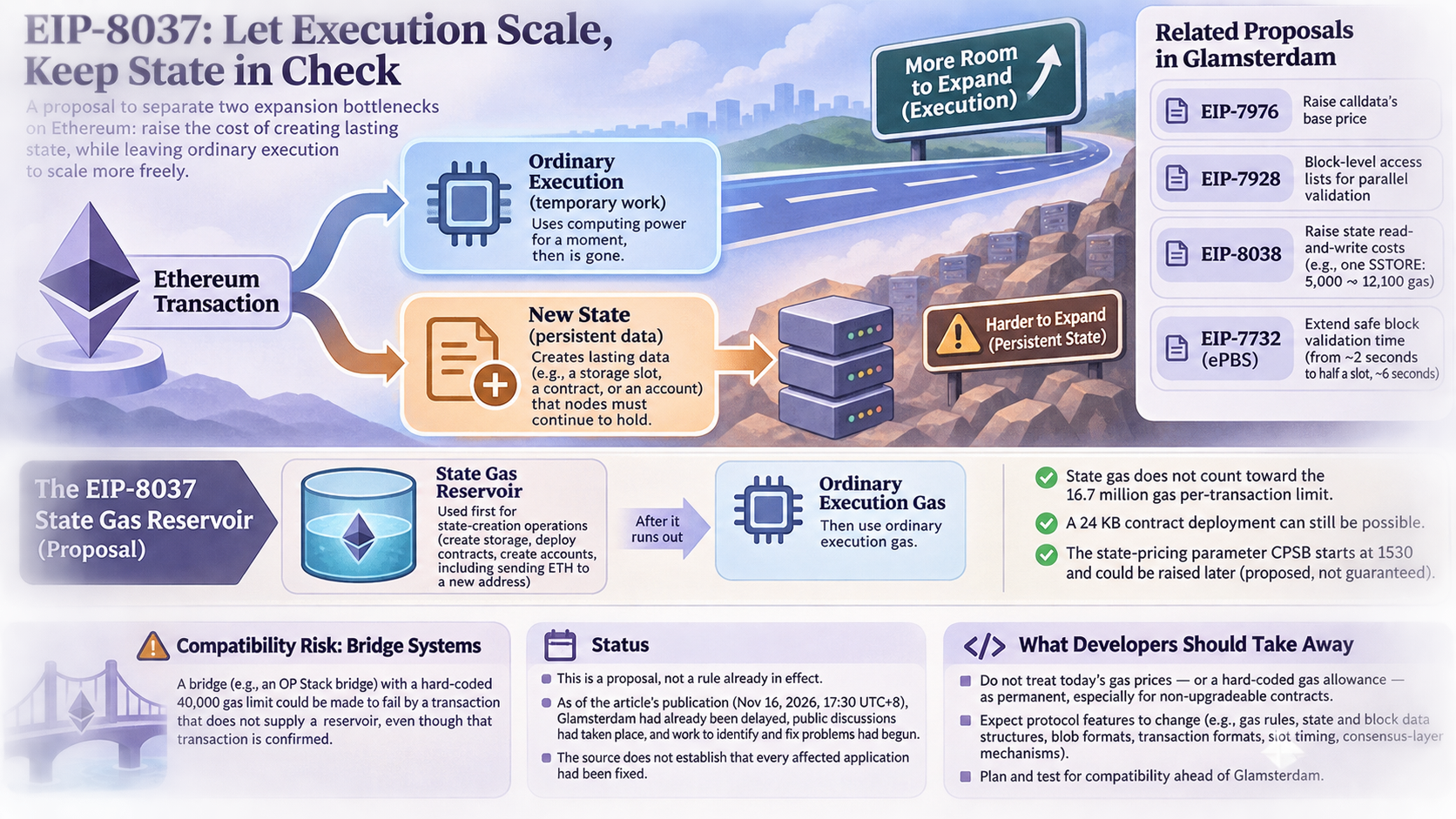
Buterin discussed protocol-level remedies, but said each brings costs or new risks. He reported that the prevailing approach among core developers was instead to work with application developers on affected contracts before Glamsterdam. As of the article’s publication, he said Glamsterdam had already been delayed, public discussions had taken place, and work to identify and fix problems had begun. The source does not establish that every affected application had been fixed.
What developers can take from the debate
For developers of non-upgradeable contracts, Buterin’s central warning is not to treat today’s gas prices—or a hard-coded gas allowance—as permanent. He called for a clearer, shared list of protocol features expected to change. His preliminary examples include gas rules, state and block data structures, blob formats, transaction formats, slot timing and consensus-layer mechanisms. These are expectations and possibilities in his article, not a schedule of enacted changes.
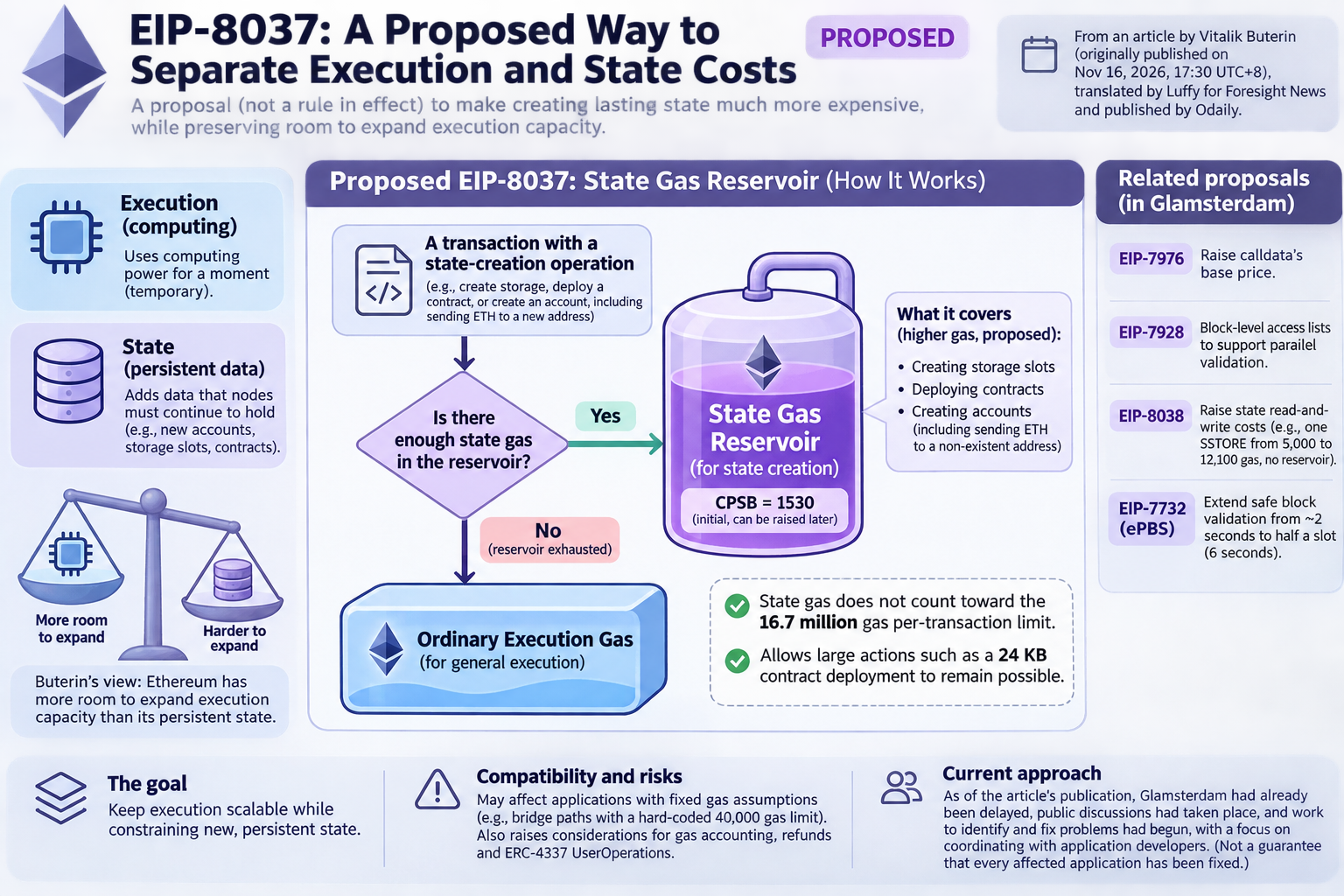
The immediate map is therefore narrow: EIP-8037 targets the cost of creating lasting state; its reservoir is meant to preserve room for execution; and compatibility work remains a prerequisite for applications whose behavior depends on fixed gas limits. Buterin presents that trade-off as a route to scaling without uncontrolled state growth, while acknowledging that the proposal does not remove every application-level risk.
Source: odaily.news (originally published 2026-11-16 17:30 UTC+8)