As reported on November 17, 2026, testing of Ethereum’s proposed Glamsterdam upgrade had exposed a compatibility risk: a transaction could succeed on the Sepolia testnet even when an internal payment failed. The finding concerns proposed changes under test, not a rule already in effect on Ethereum mainnet.
Juicebox’s tests showed why the distinction matters. In one NFT purchase simulation, the buyer received the NFT, but an internal payment ran out of gas and the unpaid funds remained in the payment project. In a token-distribution test, a cross-project payment failed after a reserved-token allocation completed, leaving the beneficiary with the project’s original tokens rather than the intended payment outcome. In a cash-redemption test, transactions using 679,622 to 817,622 gas completed while an internal 2.5% protocol fee was not paid.
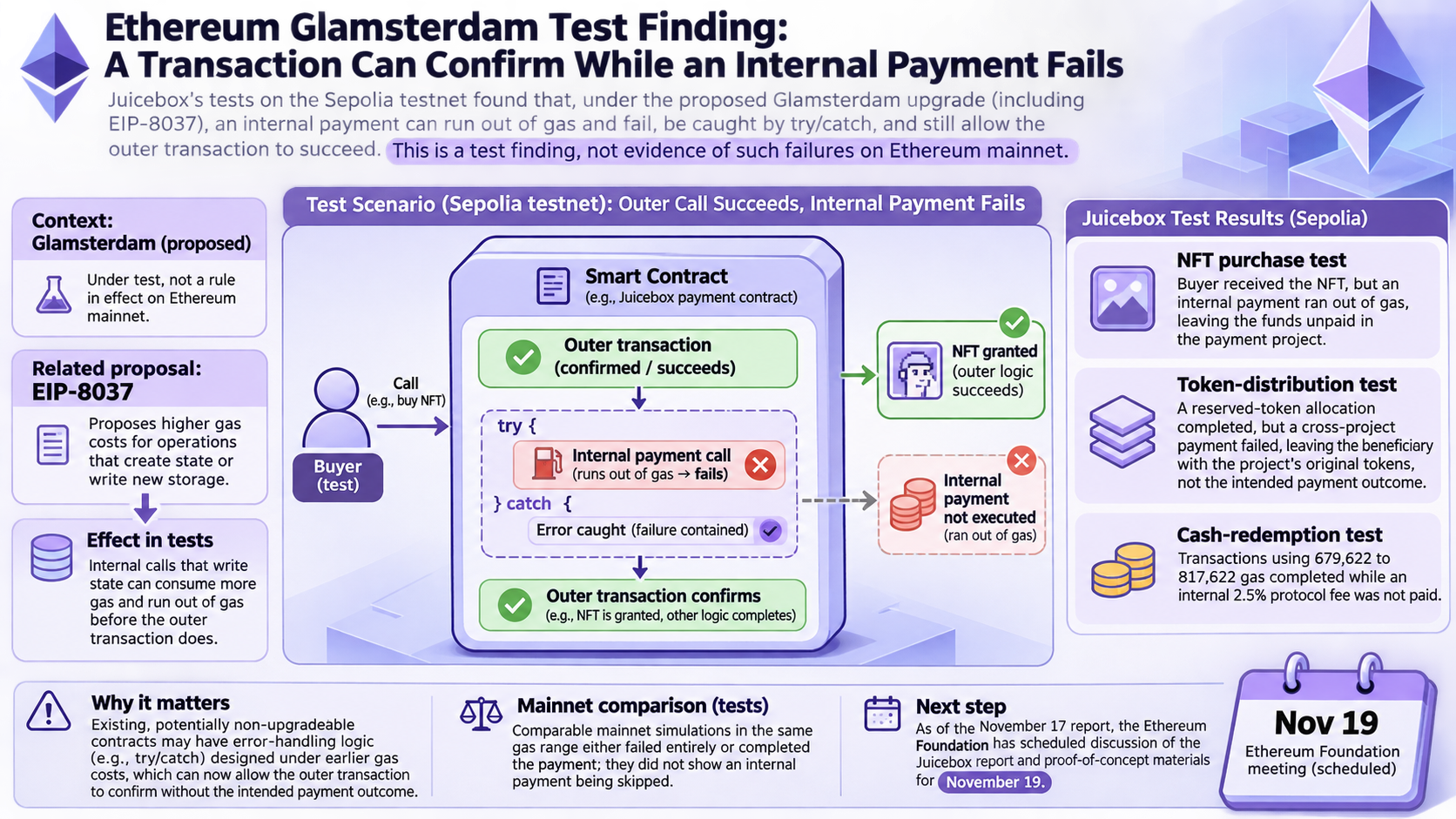
Juicebox developer mejango linked the behavior to changes in gas costs for operations that create state or write new storage, particularly those proposed in EIP-8037. Under the tested rules, an internal call could run out of gas before the outer transaction did. A contract’s try/catch handling could then contain that failure, allowing the outer transaction to confirm. The report says comparable mainnet simulations in the same gas range either failed entirely or completed the payment; they did not show an internal payment being skipped.
The concern for existing, potentially non-upgradeable contracts is that error-handling logic designed under earlier gas costs may no longer produce the intended payment outcome. This is a test finding, not evidence that the described failures have occurred on mainnet. As of the November 17 report, the Ethereum Foundation had scheduled discussion of the Juicebox report and proof-of-concept materials for November 19. No final decision on changing the proposal’s parameters had been reported.