Originally reported on November 10, 2026, at 18:00 UTC+8. The platform described below was still awaiting regulatory approval at that time.
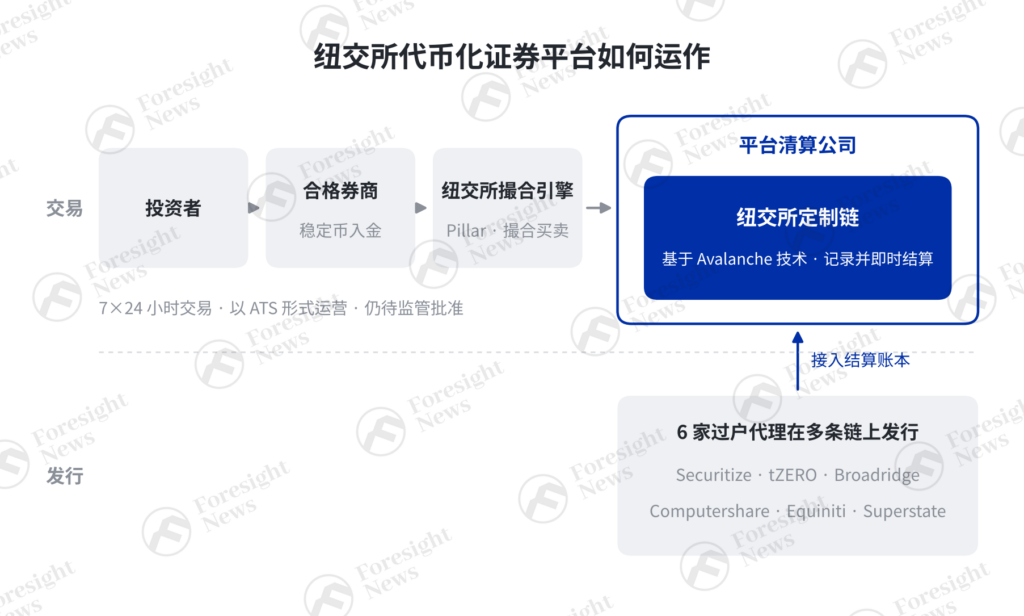
The New York Stock Exchange’s planned round-the-clock tokenized-securities platform is set to use Avalanche technology to settle stock trades. According to a November 9 Wall Street Journal report, the platform will use Avalanche exclusively for settlement. Ava Labs said its technology would provide the core ledger for the platform’s clearing company, and NYSE’s pre-market briefing confirmed the arrangement.
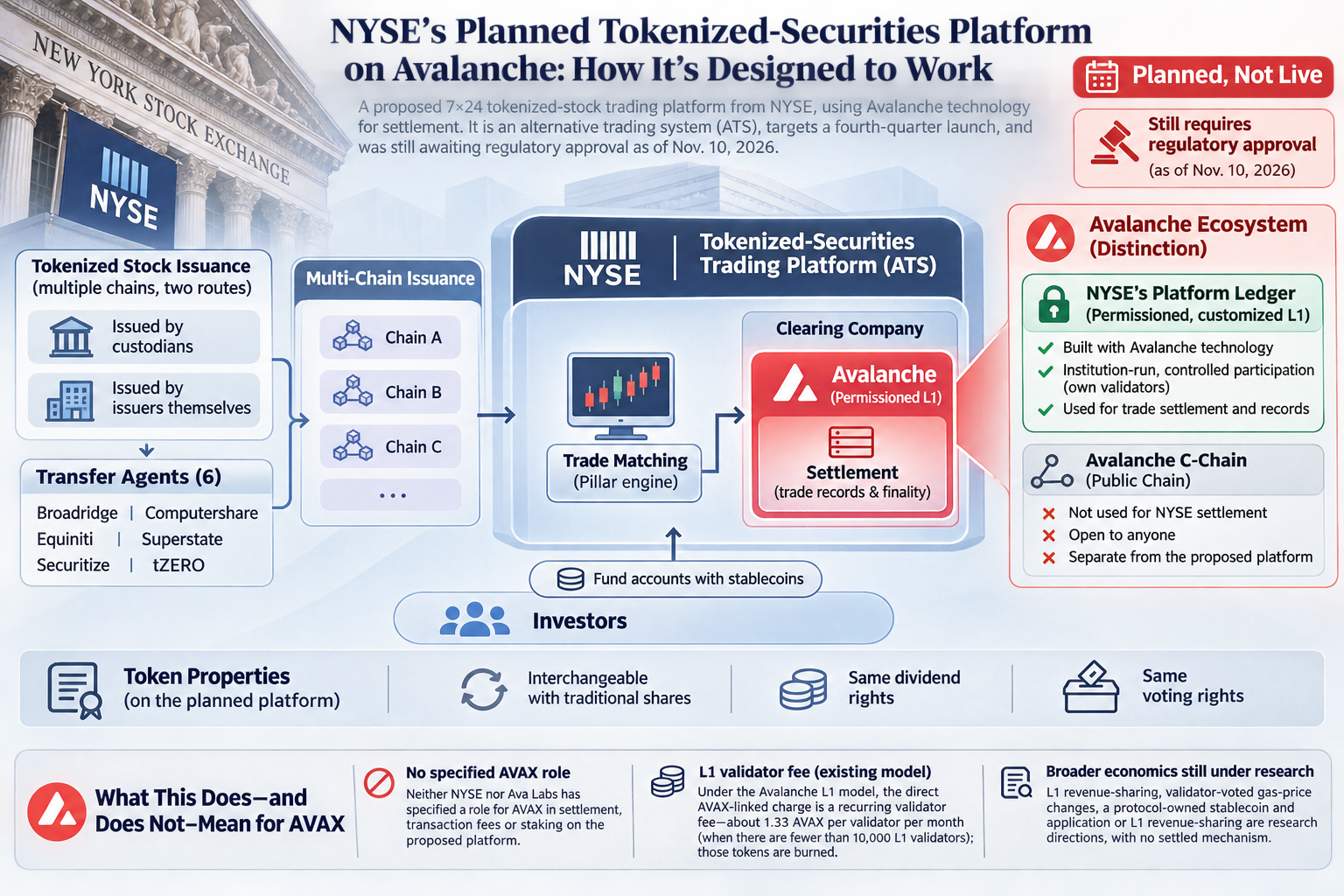
The distinction for readers exploring this infrastructure is which Avalanche network is involved. Ava Labs chief business officer John Nahas said settlement would not take place on Avalanche’s public chain. Instead, NYSE would operate a blockchain customized to regulatory requirements. The platform is planned as an alternative trading system, targets a fourth-quarter launch, and still requires regulatory approval.
How the proposed platform fits together
Under the plan disclosed November 9, NYSE’s existing Pillar engine would match trades. The platform’s clearing company would then settle them on the Avalanche-based ledger; investors could fund accounts with stablecoins. NYSE digital issuance head Dennis Lee said stocks could be issued on multiple chains, while trade records and settlement would be brought onto one controlled ledger.
NYSE had outlined the issuance side on November 2. It added Broadridge, Computershare, Equiniti and Superstate as transfer agents alongside Securitize and tZERO, bringing the named partners to six. NYSE said the platform would accommodate tokens issued either by custodians or by issuers themselves, with both types interchangeable with traditional shares and carrying the same dividend and voting rights. These are features of the proposed platform, not evidence that it has launched.
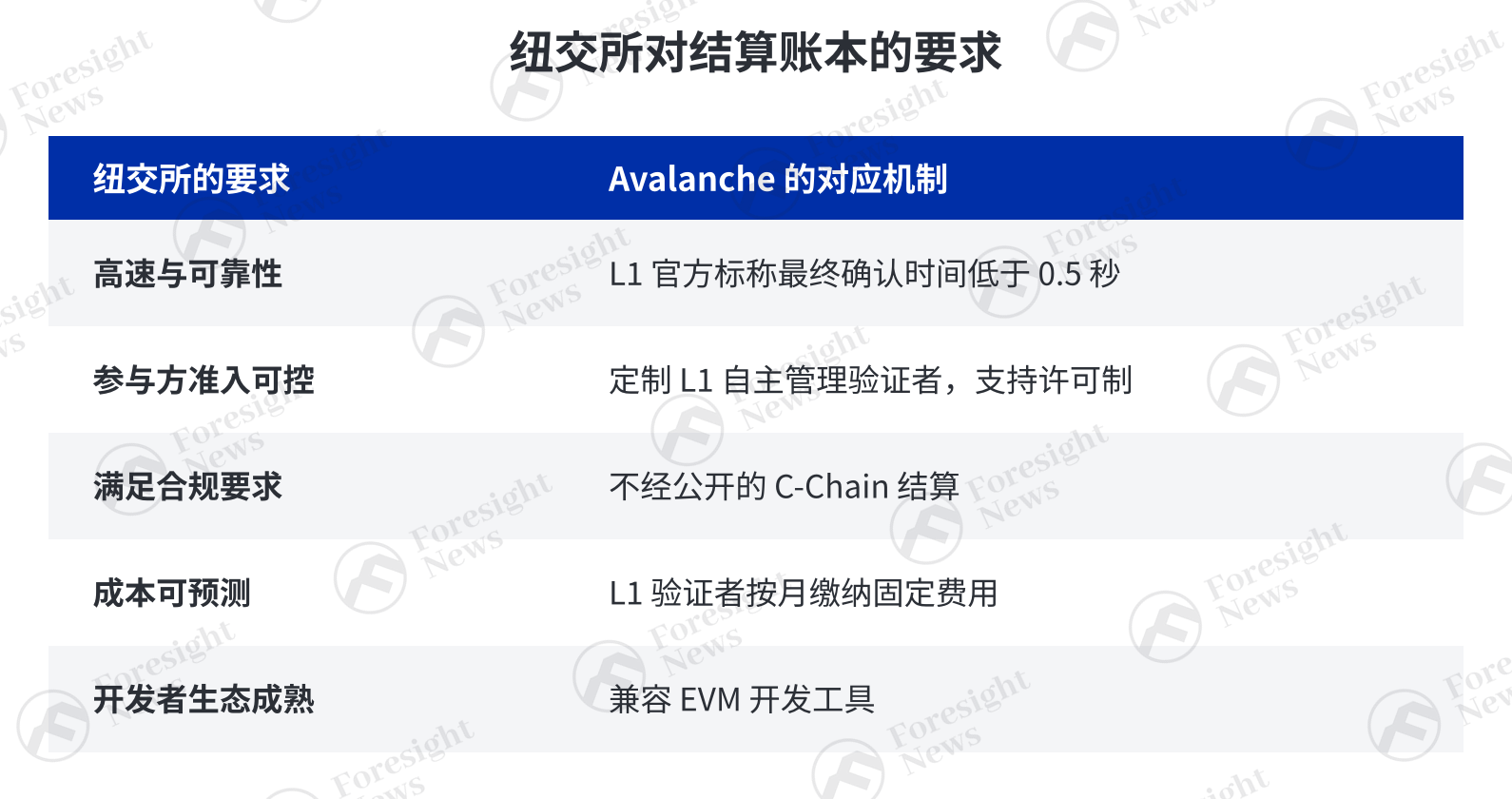
The choice of a controlled ledger is consequential. Lee cited speed, reliability, predictable costs, control over participants and a large developer community as requirements. NYSE chief product officer Kevin Tyrrell said the exchange tested multiple vendors, while Nahas said technical, commercial and ecosystem reviews took more than a year. Unlike Avalanche’s open C-Chain, an institution-run Avalanche L1 can manage its own validators and restrict participation. Ava Labs CEO Emin Gün Sirer said such dedicated infrastructure could still connect to a wider asset and liquidity ecosystem; Avalanche L1s also have native cross-chain messaging.
NYSE announced development of the platform and its pursuit of regulatory approval on January 19. Its parent, Intercontinental Exchange, signed a memorandum of understanding with tZERO on August 31. Ava Labs president Charley Cooper said at September’s Avalanche Summit that NYSE had tested Avalanche for about a year, before a selection had been announced. On November 9, he described the chosen deployment as intended for production rather than another pilot.
What the choice does—and does not—mean for AVAX
Neither NYSE’s nor Ava Labs’ announcement specified a role for AVAX in settlement, transaction fees or staking on the proposed platform. Under the existing Avalanche L1 model, the direct AVAX-linked charge is a recurring validator fee, not a fee tied to the number or value of settled trades. Avalanche documentation puts that charge at roughly 1.33 AVAX per validator per month when there are fewer than 10,000 L1 validators; those tokens are burned. An L1 operator can denominate its internal transaction fees in another token.
The Avalanche Foundation had already identified this gap between ecosystem activity and AVAX value capture in its July 30 economic research agenda. Its August 12 estimate said C-Chain fee burns—not including L1 validator fees—had totaled about $23.5 million since early 2024. L1 revenue-sharing remained under research, with no settled mechanism. The foundation also listed validator-voted gas-price changes, a protocol-owned stablecoin and application or L1 revenue-sharing as research directions, not enacted changes.
For context, rwa.xyz figures cited in the original report put Avalanche’s distributed real-world assets at $1.43 billion, represented assets at $11.4 billion and stablecoin market capitalization at $795 million as of November 9. Those ecosystem totals do not establish how much activity the NYSE platform will generate or how much value AVAX will capture. The immediate milestone remains regulatory approval, followed by any actual launch.
Source: odaily.news (originally published 2026-11-10 18:00 UTC+8)